Incoming General Assembly President to prioritize ‘Peace, Prosperity, Progress and Sustainability’

Source: United Nations 3

Ambassador Dennis Francis – who has had a nearly 40-year-career – will take the helm of the UN’s main policy-making body, starting in September. 

He was elected by acclamation during a ceremony in the iconic General Assembly Hall at UN Headquarters in New York. 

Promoting meaningful dialogue 

The General Assembly consists of all 193 UN Member States, all of which have an equal vote. Its duties include appointing the Secretary-General, on the recommendation of the Security Council, and approving the Organization’s annual budget.  

Mr. Francis said he will prioritize encouraging and facilitating meaningful dialogue. 

“It is my hope to bring forward, with your help and support, a renewed atmosphere of conciliation, cooperation and shared commitment in addressing the many challenges and seizing every opportunity, however nascent, before the General Assembly,” he said. 

“I will seek to enhance current approaches and adopt new ones with probable solutions, as we endeavour to deliver or at least to strengthen the bases for delivering Peace, Prosperity, Progress and Sustainability.” 

He also spoke about the prominent role of education in his life and career and upheld the need to ensure all people have the chance to learn, in line with the Sustainable Development Goals (SDGs), which call for ending extreme poverty and other deprivations, by 2030. 

Rebuilding trust 

The current General Assembly President, Csaba Kőrösi of Hungary, noted that his successor brings a wealth of knowledge and experience to the post. 

“Mr. Francis’ vision for the 78th session – ‘Peace, Prosperity, Progress and Sustainability’ – offers a comprehensive view of the work of the General Assembly as we rebuild trust in and within this institution, tackle climate change and strive to get the SDGs back on track,” he said

With 100 days remaining in his administration, Mr. Kőrösi said he will continue to promote the use of science for a sustainability transformation, namely in preparations for the SDG Summit during the High-Level Week of the General Assembly in September,

Critical perspective 

UN Secretary-General António Guterres added that Mr. Francis’s tenure comes at “a deeply challenging moment”, amidst conflicts, climate chaos, and escalating poverty, hunger and inequality – while the SDGs are also “slipping out of reach”. 

He said the incoming President also brings a critical perspective as many issues addressed in the General Assembly – such as climate change and an unjust global financial system – hit small island developing States like Trinidad and Tobago the hardest. 

“We look forward to the President-elect carrying forward the theme of his presidency Peace, Prosperity, Progress and Sustainability – in the year ahead, and to bringing this Assembly together to strengthen global cooperation at this difficult moment,” he said. 

A distinguished career 

Mr. Francis is currently the Permanent Representative of Trinidad and Tobago to the UN and has had a diplomatic career that spans nearly four decades.  

During this period, he held the rank of Ambassador for 18 consecutive years until his compulsory retirement in 2016, making him the country’s longest serving Ambassador. 

Before leaving office as the Director of Multilateral Relations, he served as Senior Adviser to the Minister of Foreign Affairs on all multilateral matters, including Climate Change and the negotiations for the 2030 Agenda for Sustainable Development, which contains the SDGs. 

New General Assembly President to prioritize ‘Peace, Prosperity, Progress and Sustainability’

Source: United Nations

Ambassador Dennis Francis – who has had a nearly 40-year-career – will take the helm of the UN’s main policy-making body, starting in September. 

He was elected by acclamation during a ceremony in the iconic General Assembly Hall at UN Headquarters in New York. 

Promoting meaningful dialogue 

The General Assembly consists of all 193 UN Member States, all of which have an equal vote. Its duties include appointing the Secretary-General, on the recommendation of the Security Council, and approving the Organization’s annual budget.  

Mr. Francis said he will prioritize encouraging and facilitating meaningful dialogue. 

“It is my hope to bring forward, with your help and support, a renewed atmosphere of conciliation, cooperation and shared commitment in addressing the many challenges and seizing every opportunity, however nascent, before the General Assembly,” he said. 

“I will seek to enhance current approaches and adopt new ones with probable solutions, as we endeavour to deliver or at least to strengthen the bases for delivering Peace, Prosperity, Progress and Sustainability.” 

He also spoke about the prominent role of education in his life and career and upheld the need to ensure all people have the chance to learn, in line with the Sustainable Development Goals (SDGs), which call for ending extreme poverty and other deprivations, by 2030. 

Rebuilding trust 

The current General Assembly President, Csaba Kőrösi of Hungary, noted that his successor brings a wealth of knowledge and experience to the post. 

“Mr. Francis’ vision for the 78th session – ‘Peace, Prosperity, Progress and Sustainability’ – offers a comprehensive view of the work of the General Assembly as we rebuild trust in and within this institution, tackle climate change and strive to get the SDGs back on track,” he said

With 100 days remaining in his administration, Mr. Kőrösi said he will continue to promote the use of science for a sustainability transformation, namely in preparations for the SDG Summit during the High-Level Week of the General Assembly in September,

Critical perspective 

UN Secretary-General António Guterres added that Mr. Francis’s tenure comes at “a deeply challenging moment”, amidst conflicts, climate chaos, and escalating poverty, hunger and inequality – while the SDGs are also “slipping out of reach”. 

He said the incoming President also brings a critical perspective as many issues addressed in the General Assembly – such as climate change and an unjust global financial system – hit small island developing States like Trinidad and Tobago the hardest. 

“We look forward to the President-elect carrying forward the theme of his presidency Peace, Prosperity, Progress and Sustainability – in the year ahead, and to bringing this Assembly together to strengthen global cooperation at this difficult moment,” he said. 

A distinguished career 

Mr. Francis is currently the Permanent Representative of Trinidad and Tobago to the UN and has had a diplomatic career that spans nearly four decades.  

During this period, he held the rank of Ambassador for 18 consecutive years until his compulsory retirement in 2016, making him the country’s longest serving Ambassador. 

Before leaving office as the Director of Multilateral Relations, he served as Senior Adviser to the Minister of Foreign Affairs on all multilateral matters, including Climate Change and the negotiations for the 2030 Agenda for Sustainable Development, which contains the SDGs. 

United Nations International School to Hold Graduation Ceremony at Headquarters

Source: United Nations 4

The United Nations International School (UNIS) will hold its graduation ceremony in the General Assembly Hall at United Nations Headquarters in New York on 2 June.  António Guterres, United Nations Secretary-General, will deliver the commencement address to the graduating class.

Graduating seniors will leave UNIS for 77 of the world’s universities in eight countries including Canada, France, Italy, Spain, United Kingdom and the United States, amongst others.  The 128 graduates represent 64 nationalities and speak 27 home languages.  Thirty-five students have been at UNIS since kindergarten and approximately 50 per cent of the student families are affiliated with the United Nations.

Taught and supported by staff and faculty representing 57 countries, students receive an academically rigorous international education in nine languages.  Under the auspices of the United Nations, UNIS fosters innovation, creativity and cross-cultural communication, educating and inspiring its students to become an active force in shaping a better world:  peaceful, compassionate and sustainable.

For more information, please contact Daniella Musmani Brenes at email:  dmusmani@unis.org or tel.:  +1 609 622 9739.

Secretary-General Appoints Marguerite El Helou Director of United Nations Information Centre in Cairo

Source: United Nations 4

United Nations Secretary-General António Guterres has appointed Marguerite El Helou of Lebanon as Director of the United Nations Information Centre (UNIC) in Cairo.  She assumed her new duties on 1 June 2023.

A field office of the United Nations Department of Global Communications, the United Nations Information Centre in Cairo provides services to Egypt and Saudi Arabia.

Ms. El Helou has 25 years of experience in communications, including eight years as Director, UNIC Beirut.  She also worked for the Economic and Social Commission for Western Asia. Prior to the United Nations, she was responsible for communications in the Near East for Procter & Gamble and a marketing manager for several companies.

Ms. El Helou has extensive experience in designing and implementing communication strategies for the United Nations in the Middle East and North Africa.  She has developed communications campaigns on the Sustainable Development Goals, climate change, women’s empowerment, migration, racism and hate speech.  She has worked with both traditional and digital media, including the web and social media platforms.  She also has a wide knowledge of the media scene in the Middle East and North Africa region as well as a deep understanding of the political, economic and social issues in the region.

Ms. El Helou holds a bachelor’s degree in agriculture from the American University of Beirut as well as certificates in media, television, external relations, marketing and business solutions.  She is fluent in English, French and Arabic.

New Permanent Observer for Economic Community of West African States Presents Letter of Appointment

Source: United Nations 4

(Based on information provided by the Protocol and Liaison Service)

The new Permanent Observer for the Economic Community of West African States (ECOWAS) to the United Nations, Kinza Jawara-N’Jai presented her letter of appointment to UN Secretary-General António Guterres today.

Prior to her appointment, Ms. Jawara-N’Jai served as Principal Programme Officer and Head of Division for Cross-Border Co-operation of ECOWAS since 2008.  From 2006 to 2007, she worked as an international consultant for the United Nations Development Programme (UNDP) and the United Nations Development Fund for Women as a technical adviser to the Ministry of Gender and Social Affairs in the Office of the Prime Minister of Rwanda.

She has also served in various capacities as a civil servant in the Office of the President of the Gambia, including as Permanent Secretary and Senior Adviser to the President from 2003 to 2005; Deputy Permanent Secretary and Chief Technical Advisory to the First Lady from 2000 to 2003; Principal Assistant Secretary from 1999 to 2000; and Senior Assistant Secretary from 1995 to 1999.  She first joined the Office as a Cadet Administrative Officer and Assistant Secretary in 1992.

Ms. Jawara-N’Jai holds a Master of Arts in international political economy from the University of Warwick and a Bachelor of Arts in international studies from Webster University, both in the United Kingdom. Born in Kinshasa in 1967, she is fluent in English, French, Soninke, Wolof, Creole and Mandinka.  She is married, with two children.

New Permanent Representative of Angola Presents Credentials

Source: United Nations 4

(Based on information provided by the Protocol and Liaison Service)

The new Permanent Representative of Angola to the United Nations, Francisco José da Cruz, presented his credentials to UN Secretary-General António Guterres today.

Prior to his appointment, Mr. da Cruz served as his country’s Ambassador Extraordinary and Plenipotentiary to Ethiopia and Djibouti from 2019 to 2023.  During that time, he also was the Permanent Representative of Angola to the African Union and the United Nations Economic Commission for Africa (ECA).

Between 2011 to 2019, he served within Angola’s Ministry of External Relations, including as Director of the Europe Directorate from 2016 to 2019, Director of the America Directorate from 2014 to 2016 and Director of the Studies and Analysis Office from 2012 to 2014.

He has also held several roles in the private sector, including with BP Angola from 2002 to 2007.  He first served within the Permanent Mission of Angola to the United Nations as an Assistant to the Ambassador from 1990 to 1992.

Mr. da Cruz holds a Master of Business Administration and a Bachelor of Business Administration, both from Strayer University in the United States.

Born in Kalandula in 1955, he is fluent in Portuguese, English, French and Spanish.

Ukraine: Over 1,500 children killed or injured, concern rises over forced transfers

Source: United Nations

Russian attacks overnight, killed three people – including the girl’s mother – and wounded 11 others, according to news reports. It followed a reported 17 strikes on the capital during May, and the fourth this week.

More than 1,500 killed, injured

Ms. Brown expressed her sympathy to the families of “over 1,500 children killed and injured in Ukraine” since Russia’s full-scale invasion began 15 months ago. 

Ms. Brown added that the UN continued to follow closely reports of Ukrainian children being forcibly sent to Russia. 

‘Heavy price’

The head of the UN Human Rights Monitoring Mission in Ukraine, Matilda Bogner, deplored on Thursday that “civilians, including children, continue to pay a heavy price” in the war.

Behind every death there is an immeasurable human tragedy. This must stop now,” she said.

According to UN monitors, six children were killed and 34 were wounded in the month of May alone.

Towns and cities under attack

The Mission said that a total 535 children were killed and 1,047 injured since the start of the conflict. A vast majority – 87 per cent – of the casualties were caused by “explosive weapons with wide area effects”, including artillery, missile and air strikes, and “loitering munitions” also known as suicide drones.

The findings align with earlier warnings from the UN-appointed Independent International Commission of Inquiry on Ukraine about Russian armed forces carrying out attacks with explosive weapons in populated areas “with an apparent disregard for civilian harm and suffering, failing to take the required precautions”.

“The attacks were indiscriminate and disproportionate, in violation of international humanitarian law”, the Commission wrote in March.

Impact on health

Bringing even more evidence of the suffering of civilians in the war, just two days ago, the World Health Organization (WHO) verified the 1,000th attack on healthcare in Ukraine since the full-scale Russian invasion.

The agency said that this was the highest number it had ever recorded in any humanitarian emergency.

UN humanitarian coordinator Denise Brown also highlighted the “devastating impact” of the war on the mental health and well-being of children, “including millions who have had to flee for their lives”. 

She pledged the humanitarian community’s support to Ukraine’s children “for as long as it is necessary.” 

Mounting evidence of child deportations

The Commission of Inquiry on Ukraine said in March that cases of transfer and deportation of children which it had examined, amounted to war crimes. 

That same month, the UN’s rights monitoring mission released a report documenting cases of children subjected to forced transfers, arbitrary detention, enforced disappearance, torture and ill-treatment.

The report called on Russia to ensure that any evacuation, including of children, is conducted in full respect of international human rights law and international humanitarian law, and to “adhere to the prohibition of changing the personal status of children displaced from Ukraine, including nationality, and of adoption” during or immediately after an emergency, in line with international standards.

Echoing the allegations, on 17 March, the UN-backed International Criminal Court (ICC) issued arrest warrants for Russia’s President Vladimir Putin and Commissioner for Children’s Rights Maria Lvova-Belova, in connection with possible war crimes concerning the deportation and “illegal transfer” of children from occupied Ukraine.

Urgent support needed for Chad, as arrivals from Sudan top 100,000: UNHCR

Source: United Nations 2

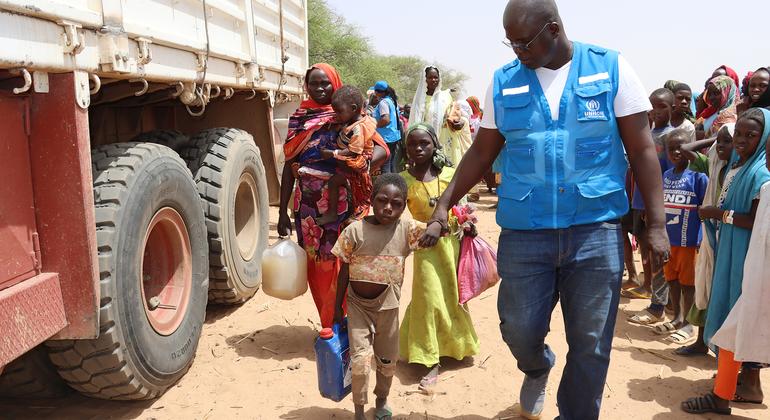
The number fleeing violence in Sudan since fighting between rival militaries began in mid-April in Khartoum, quickly destabilizing the entire country, has now topped 100,000.

The majority of arrivals in eastern Chad – particularly Ouaddaï, Sila, and Wadi Fira provinces – are from the Darfur region, which has been deeply impacted by violence for decades, reminded UNHCR.

Thousands more on the move

“Reports from our teams on the border indicate that new waves of arrivals are still ongoing”, the agency said in a press release, estimating that up to 200,000 people may be forced to flee to eastern Chad in the coming three months.

UNHCR and its partners have been working closely with the Chadian government, providing support and coordinating the emergency response to address the needs of the newly arrived refugees.

Laura Lo Castro, UNHCR Representative in Chad, said humanitarians had “been working around the clock providing protection services, including specialized assistance to survivors of violence and children at risk, constructing boreholes and well, installing emergency latrines, running mobile clinics, organizing complex relocation convoys, scaling up camps capacity to accommodate newly arrived refugees in existing refugee camps, building family shelters and community infrastructures and we are starting to build new camps.”

The agency said the rainy season was fast approaching, requiring a massive logistical exercise to move refugees from border areas for their safety and protection.

Scrambling to build new camps

“We need to establish immediately new camps and extension of existing camps”, the agency said. “As host populations are gravely affected by the situation in Sudan, some assistance will need to be extended to the most vulnerable among the host population.”

UNHCR stressed that more funding was essential to provide lifesaving interventions.

Long-standing crisis

Prior to this crisis, Chad already hosted nearly 589,000 refugees, including 409,819 Sudanese fleeing conflict in Darfur, as of March 2023.

Nearly 128,000 refugees are in the country from the Central African Republic; 21,287 Nigerians escaping violence by Boko Haram, are present in the Lake region; 28,311 Cameroonians affected by inter-communal tensions, and 1,507 refugees from other nations.

© UNHCR/Aristophane Ngargoune

Tens of thousands of refugees have arrived in Chad from Sudan.

Additionally, an estimated 381,289 Chadians are internally displaced, primarily in the Lake Chad Province.

Displaced communities continue to face insecurity in Chad and neighboring countries, compounded by food insecurity, malnutrition, the effects of climate change, and a lack of livelihood opportunities.

The protracted nature of displacement has strained services, natural resources, and social cohesion, said UNHCR.

‘Beacon of hope’

“For families uprooted by the crisis, the humanitarian assistance is their beacon of hope”, added Ms Lo Castro. We rely on the compassion and generosity of our partners to rally together to ensure the provision of critical protection and life-saving support. Together, we can save lives and restore dignity to those in desperate need”.

There is a need for $214.1 million urgently, to provide lifesaving protection and assistance to Chad’s forcibly displaced, which includes $72.4 million for the emergency response for refugees fleeing conflict in Sudan, reiterated UNHCR.

Celeste Saulo of Argentina appointed first female Secretary-General of WMO

Source: World Meteorological Organization

Celeste Saulo of Argentina appointed first female Secretary-General of World Meteorological Organization

Geneva, 1 June 2023 (WMO) – Prof. Celeste Saulo of Argentina has been appointed as the first female Secretary-General of the World Meteorological Organization (WMO), taking the helm of an organization at the fore of international efforts to monitor and tackle climate change and increasingly extreme weather.

Prof. Saulo, has been Director of the National Meteorological Service of Argentina since 2014 and is currently the First Vice-President of WMO. She will take office on 1 January 2024 and succeeds Prof Petteri Taalas, who has completed his two-term mandate.

Prof. Saulo was appointed after receiving the requisite two thirds majority of votes from delegates at the quadrennial World Meteorological Congress, the top decision-making body of the 193-Member WMO.

The Congress is also due to elect the WMO President and Vice-Presidents and its Executive Council.

“In these times when inequality and climate change are the greatest global threats, the WMO must contribute to strengthening the Meteorological and Hydrological Services to protect populations and their economies, providing timely and effective services and early warning systems,” Prof. Saulo said.

“My ambition is to lead the WMO towards a scenario in which the voice of all Members is heard equally, prioritizing those most vulnerable and in which the actions it undertakes are aligned with the needs and particularities of each one of them,” said Prof. Saulo.

Career background

Prof. Saulo pursued a career in academia: she combined her calling for science and teaching with university management and the connection of scientific research with the needs of the society.

At the National Meteorological Service of Argentina, she promoted substantive organizational changes, based on a management that strives for concrete results, meets social demands, articulates at national, regional and international levels, and cultivates equity, inclusion and mutual respect.

Prof. Saulo  has long involvement with WMO. She was elected in June 2015 as a member of the WMO Executive Council. In April 2018, she was elected as Second Vice-president for WMO and, in June 2019, she was elected First Vice-President, becoming the first woman to hold the office.

Prior to that, Prof. Saulo was a member of various WMO expert scientific panels.

Until 2018, she was a member of the Scientific Steering Committee for the World Weather Research Program (WWRP). She has also been a member of the Working Group on Seasonal to Interannual Prediction and of the WCRP/CLIVAR Panel for the Variability of the American Monsoon Systems.

Her research has been key for better understanding the South American Monsoon System, and the associated patterns of precipitation and circulation during the warm season. In the last few years, she deepened her activity on interdisciplinary problems such as wind energy production, agricultural applications, and early warning systems.

She has authored or co-authored more than 60 peer-reviewed scientific journal articles and book chapters. She supervised many students both at the undergraduate and graduate levels and, acting as Principal Investigator in 23 research projects financed by national and international agencies.

Her vast teaching experience has been mainly related with numerical weather prediction, atmosphere dynamics and thermodynamics, mesoscale meteorology, cloud dynamics and cloud microphysics.

Prof. Saulo is married with two children.

She says her favorite activities are playing tennis, cooking for her family and dancing Latin rhythms. She is passionate about music, enjoys reading and cinema.

The World Meteorological Organization is the United Nations System’s authoritative voice on Weather, Climate and Water


For further information contact:

Clare Nullis, WMO media officer, cnullis@wmo.int. Tel 41-79-709 13 97

Adopting 3 texts, General Assembly Appropriates Extra Funding of $14.59 Million to Maintain Peacekeeping Missions in Abyei, Golan, South Sudan

Source: United Nations 4

Speakers Outline Plans to Protect Future Generations as Delegates Resume Review of Sendai Framework for Disaster Risk Reduction 2015-2030

Stressing the urgency of managing the risks of natural and man-made disasters to protect future generations, the General Assembly today resumed its review of the Sendai Framework for Disaster Risk Reduction 2015-2030 after adopting three resolutions that will deliver nearly $15 million to the special accounts of three peacekeeping missions.

The three consensus resolutions, approved by the Fifth Committee (Administrative and Budgetary) at its 24 May meeting, will help keep two peacekeeping missions in Africa and one in the Middle East running smoothly until the end of June.  Together, the texts provide $14.59 million in additional funding for the missions’ 2022/23 fiscal year.

By the terms of the text “Financing of the United Nations Interim Security Force for Abyei” (document A/77/890), the Assembly decided to appropriate an additional $8.51 million for the Force’s maintenance until the end of June, on top of the $259.66 million already allocated for that fiscal year through its resolution 76/281.  By the text “Financing of the United Nations peacekeeping forces in the Middle East:  United Nations Disengagement Observer Force” (document A/77/891), it decided to appropriate an extra $1.03 million for that Force’s maintenance through June, on top of the $64.54 million it previously allocated for 2022/23 by its resolution 76/289. Similarly, through the terms of “Financing of the United Nations Mission in South Sudan” (document A/77/892), the Assembly appropriated $5.05 million for that Mission’s maintenance until June’s end, on top of the $1.12 billion it already allocated under its resolution 76/291.

After a two-day, high-level meeting held at United Nations Headquarters earlier this month, delegates took to the General Assembly Hall again and renewed their commitment for collective action to curb the loss of lives and property from floods, earthquakes, pandemics and other disasters by the Framework’s 2030 target date.  Delegates agreed the need for action at the global, national and local levels is only accelerating as many vulnerable, developing countries struggle to achieve the Sustainable Development Goals by 2030.

At the meeting’s opening day on 18 May, delegates had adopted by consensus a political declaration reiterating the Framework’s call to substantially limit risk and loss while acknowledging that conventional approaches are no longer sufficient.  (For background, see Press Release GA/15202). 

Amery Browne, Minister for Foreign and Caribbean Community (CARICOM) Affairs of Trinidad and Tobago, said that since the adoption of the Sendai Framework in 2015, the Caribbean region has been pummelled with greater frequency by natural disasters of increased severity.  The outcome has produced severe economic and development setbacks for people, particularly women and girls.  Yet financing remains elusive as the slew of natural disasters, along with the pandemic, has reduced Government revenue.  At the same time, many developing countries, particularly small island developing States, face rising debt levels and are frequently denied access to international financing that can help them recover and create resilience.

He said the international community cannot continue business as usual if it is serious about not leaving anyone behind.  The lessons learned from this midterm review must be transferred into urgent and concrete actions.  “Resilience is not the absence of risk, but the ability to make progress every day in spite of it,” he said.

Echoing that concern, Colombia’s delegate stressed that until the international community takes transformative action to mitigate the climate crisis, it will not meet the Sendai Framework’s goals.  “Most disasters have a female face,” she said, adding that women and girls are more likely to die in disasters than men and are more vulnerable during post-disaster situations and humanitarian emergencies. In addition, Indigenous peoples’ adaption and resilience should be grounded in a holistic approach that preserves harmony with nature.

Namibia’s delegate also drew attention to the socioeconomic consequences of disasters.  Climate change will amplify the uneven distribution of disaster risk, further exacerbating poverty, he said, cautioning that this can spark migration swells that could affect peace and security over the long term.  Stand-alone approaches to reducing climate and weather hazards are unlikely to be effective if they don’t consider underlying factors.

Haiti’s delegate — whose country is also vulnerable to disasters and has the unfortunate distinction of having the grimmest record of deaths in the wake of a disaster over the past 20 years — pointed out that natural disasters strike the poorest the hardest.  In that regard, strengthening resilience is essential to protect people, their livelihoods and their meagre assets.  To that end, Member States have a collective duty to strengthen governance, reduce disaster risk and build resilience.

To help thwart disasters before they can occur and mitigate the consequences of unavoidable events, many Governments are intent on developing national and local plans, programmes and agencies.

Papua New Guinea, for example, has created a Vision 2050 development road map and successive medium-term development plans that make disaster risk reduction a key priority, said the Pacific Ocean delegate.  He said his country’s high vulnerability to natural disasters, including earthquakes, tsunamis, volcanic activity, cyclones and droughts, is just compounded by the adverse impact of climate change and rising sea-levels.  The country’s National Disaster and Risk Reduction Framework 2017-2030 also lays down the basis for the country’s disaster risk reduction work, led by its National Disaster Centre.  He underscored the importance of local communities and faith-based organizations’ participation, with special attention paid to the role of women and youth in disaster risk reduction activities. 

Along similar lines, Nauru’s delegate highlighted his country’s substantive progress since the signing of the Sendai Framework, especially in terms of strengthening disaster risk governance.  The risk to Nauru’s existence due to sea level rise, the increased intensity and frequency of storm surges and increased incidence of prolonged periods of drought are a stark reality.  “Our ability to access sustainable financing thus determines our ability to deliver on the priorities articulated in the Sendai Framework,” she stressed, calling on the international community to create tailored financing solutions for small island developing States.

The representative of Chile said the South American nation in 2020 formalized a 2020-2030 national strategic plan that incorporates elements of sustainable development, climate action and humanitarian action into its risk management policy.  In 2021, a national disaster prevention and response system was created that aims to manage all stages of disaster from the local to national level.  A national platform set up in 2012, for example, brings together 200 private and public bodies, including representatives from academia and civil society.  This model has been replicated in 16 regional platforms while progress is being carried out to ensure hundreds of municipalities have their own municipal emergency or disaster risk reduction plan.  So far, 65 municipalities have plans  in place.  “We share challenges and can work together to identify the topics of convergence and put science and technology at the service of people,” she said, pointing to the importance of early warning systems.

In the same vein, the speaker for Cambodia said the country’s National Action Plan for Disaster Risk Reduction 2019-2023 has been implemented in line with the Sendai Framework.  Some of Cambodia’s latest measures to boost its preparedness for disaster risk include, inter alia, the construction of evacuation centres in six flood-prone provinces, development of platforms for real-time impact and situation monitoring application and 16 additional national search and rescue teams.  Despite the significant progress, Cambodia urgently requires more modern technologies to effectively deal with natural calamities.

As a mountainous landlocked country, Bhutan remains vulnerable to various climate-induced floods, landslides, earthquakes and wildfires. The country has developed a legal and institutional framework for disaster risk reduction by promulgating a Disaster Management Act and has developed national guidelines to integrate disaster risk reduction into development policies.  Investing in disaster-resilient infrastructure and building community resilience is a priority for his country, he said, calling for financial assistance, as Bhutan prepares to graduate from least developed country status.

Several delegates said unilateral coercive measures create hurdles for countries intent on implementing national plans for disaster risk reduction and response.  Recalling the landslides and floods that struck Venezuela in October 2022, Venezuela’s delegate pointed to the Government’s efforts despite “the so-called sanctions” imposed by the United States.  The Governments of Chile, Syria and Türkiye have acknowledged the effectiveness of Venezuela’s teams deployed in those countries, she said, asking how much more the country could do if it weren’t subject to economic, trade and financial sanctions.

The representative of Belarus said she regretted that the political declaration did not reflect the unacceptability of unilateral coercive measures.  Resilience against natural catastrophes calls for international and regional cooperation. Unilateral sanctions limit such cooperation and threaten people and States that are at a higher risk of natural disasters.  Echoing that concern, Nicaragua’s delegate also called for an end to unilateral coercive measures, noting that many of these are aimed at developing countries.  His country puts “people, family and community” at the heart of all its disaster risk reduction policies, he said.

Syria’s delegate emphasized that the cross-border nature of disasters requires collective efforts to manage and reduce the risks.  The Sendai Framework aims to manage the risks before they take place, yet this requires funding and digital transformation.  Syria, he said, is deprived of these essential elements due to unilateral coercive measures, which are imposed with complete indifference to their impact on people’s need to improve resilience to disasters.  Syria recently suffered a devastating earthquake, resulting in thousands of victims and destroyed infrastructure, he recalled, asking:  “How many deaths could have been avoided if Syria had had access to the necessary rescue equipment?”

Cautioning that hard-won development gains are at risk of being swept away, Türkiye’s representative said the earthquakes her country experienced in February were so massive that no State could have overcome such a disaster alone.  Stressing the significance of disaster preparedness, she said those earthquakes demonstrated how essential the Government’s recent focus on disaster risk management was to its response.  The Government had updated and implemented several risk reduction plans; developed an integrated alarm warning system which allowed citizens to transmit data via their smartphones during the disaster; and launched a seismometer network to monitor fault lines.  While the recovery and reconstruction process will be a long journey, her country will not simply rebuild destroyed structures and replace losses, but rather aims to build back better, greener and smarter with disaster resilience and energy efficiency at the core, she said.